
Many SQL developers choose CTEs, Temp Tables, or Derived Tables based on syntax or readability – but the execution plan tells the real story.
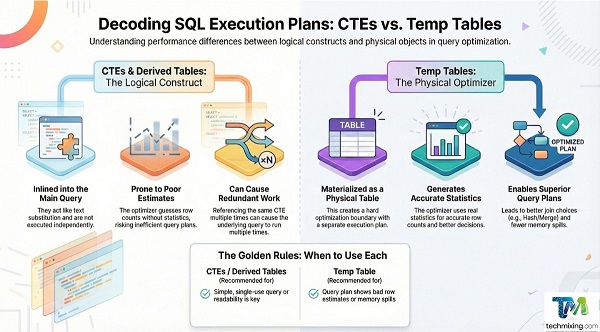
This article explains:
- How SQL Server generates execution plans for each
- Why CTEs and Derived Tables often behave the same
- When Temp Tables change the plan dramatically
- How to read execution plans correctly
- Real examples with operator-level analysis
1. What Is an Execution Plan (Quick Refresher)
An execution plan shows:
- How SQL Server accesses data
- Join methods (
Nested Loop,Hash Match,Merge) - Index usage (
Index Seek,Index Scan) - Estimated vs actual rows
- Memory grants and spills
Key point:
SQL Server optimizes the final query, not how you wrote it.
2. Execution Plan for CTEs
Example CTE
WITH SalesCTE AS (
    SELECT CustomerID, SUM(Amount) AS TotalSales
    FROM Sales
    GROUP BY CustomerID
)
SELECT *
FROM SalesCTE
WHERE TotalSales > 100000;
What the Execution Plan Shows
- No separate operator for
SalesCTE - The CTE is expanded (inlined) into the main query
- Operators typically include:
Index Scan / SeekStream AggregateFilter
Important
A CTE is NOT executed independently.
It behaves like query text substitution.
Performance Trap
If the CTE is referenced multiple times:
WITH BigCTE AS (
    SELECT * FROM Orders WHERE OrderDate >= '2024-01-01'
)
SELECT COUNT(*) FROM BigCTE;
SELECT SUM(Amount) FROM BigCTE;
Execution plan shows two separate scans of Orders.
3. Execution Plan for Derived Tables
Example Derived Table
SELECT *
FROM (
    SELECT CustomerID, SUM(Amount) AS TotalSales
    FROM Sales
    GROUP BY CustomerID
) AS DT
WHERE TotalSales > 100000;
Execution Plan Reality
- Almost identical to the CTE plan
- Same operators
- Same join strategy
- Same estimated cost
Key Insight
Derived tables and CTEs usually produce the same execution plan.
Difference Is:
- Readability
- Reusability
– not execution behavior.
4. Execution Plan for Temp Tables (Big Difference)
Example Temp Table
SELECT CustomerID, SUM(Amount) AS TotalSales
INTO #SalesTemp
FROM Sales
GROUP BY CustomerID;

SELECT *
FROM #SalesTemp
WHERE TotalSales > 100000;
Execution Plan Characteristics
You now get two plans:
Plan 1: Populate Temp Table
Index Scan / SeekonSalesAggregateInsertinto#SalesTemp
Plan 2: Query Temp Table
Clustered Index Scan(or Seek if indexed)- Accurate row estimates
- Possible index usage
Temp tables introduce a physical boundary
5. Statistics & Cardinality Estimation (Huge Factor)
CTE / Derived Table
- No statistics
- Optimizer guesses row counts
- Can cause bad join choices
Temp Table
- Statistics automatically created
- Accurate row estimates
- Better join algorithms
This is why temp tables often fix bad execution plans.
6. Join Strategy Differences (Very Important)
Scenario: Large Dataset Join
Using CTE
WITH BigOrders AS (
    SELECT * FROM Orders WHERE OrderDate >= '2024-01-01'
)
SELECT *
FROM BigOrders o
JOIN Customers c ON o.CustomerID = c.CustomerID;
Execution Plan:
- Nested Loop (bad for large data)
- Underestimated rows
Using Temp Table
SELECT *
INTO #BigOrders
FROM Orders
WHERE OrderDate >= '2024-01-01';

SELECT *
FROM #BigOrders o
JOIN Customers c ON o.CustomerID = c.CustomerID;
Execution Plan:
- Hash Match or Merge Join
- Accurate memory grant
- Better performance
7. Memory Grants & Spills
CTE / Derived Table
- Memory grant based on estimates
- Underestimation → TempDB spills
- Overestimation → Wasted memory
Temp Table
- Memory grant based on real statistics
- Far fewer spills
- Predictable behavior
8. Actual vs Estimated Rows (Red Flag Area)
| Pattern | What You See |
|---|---|
| CTE / Derived | Estimated: 1 row, Actual: 1,000,000 |
| Temp Table | Estimated ≈ Actual |
Always check:
- Actual Execution Plan
- Operator warnings (⚠️ yellow triangles)
9 Execution Plan Reuse & Recompilation
CTE / Derived Table
- Plan cached with query
- Can suffer from parameter sniffing
Temp Table
- Often triggers recompilation
- Fresh statistics
- More stable plans
In reporting & ETL workloads, this is a big advantage.
10. Execution Plan Comparison Summary
| Feature | CTE | Derived Table | Temp Table |
|---|---|---|---|
| Separate plan node | NO | NO | YES |
| Statistics | NO | NO | YES |
| Accurate estimates | NO | NO | YES |
| Reuse cost | High | High | Low |
| Debuggable | NO | NO | YES |
11. Golden Rules from Execution Plans
If execution plan shows bad row estimates → use Temp Table
If query is simple and single-use → CTE / Derived
If plan has memory spills or nested loops on large data → Temp Table
If readability matters → CTE
If performance matters → Temp Table
Final Verdict (Based on Execution Plans)
CTEs & Derived Tables are logical constructs
Temp Tables are physical optimization tools
Think Like the Optimizer
- CTE ≈ Derived Table ≈ Inline View
- Temp Table = Optimization boundary
Discover more from Technology with Vivek Johari
Subscribe to get the latest posts sent to your email.

