
Introduction: Understanding the Power of SQL Queries
Structured Query Language (SQL) is the backbone of data manipulation and retrieval in modern databases. Whether you’re working with MySQL, PostgreSQL, SQL Server, or Oracle, SQL provides powerful tools to extract insights from data efficiently. Among these tools, Common Table Expressions (CTEs) and subqueries play crucial roles in simplifying complex data operations.
However, many developers—especially beginners—often wonder what exactly distinguishes a CTE from a subquery, when to use one over the other, and how each impacts readability, performance, and maintainability.
Both Structured Query Language (SQL) and CTE allow developers to break down intricate logic into smaller, more manageable parts. While they often achieve similar results, their structure, reusability, and suitability for different tasks distinguish them. Choosing the right tool (Common Table Expressions (CTEs) or subqueries) largely depends on the complexity of the query, the need for code reuse, and the importance of readability.
This guide dives deep into the difference between CTE and subqueries in SQL, providing examples, use cases, and optimization tips that will make you a more efficient SQL developer.
What Is a CTE (Common Table Expression)?
A Common Table Expression (CTE) is a temporary, named result set that exists within the scope of a single SQL statement. It’s defined using the WITH keyword and allows you to reference its result multiple times in the main query.
In simple terms, a CTE acts like a virtual table—you define it once and then query it as if it were a regular table.
Syntax and Basic Structure of a CTE
CTEs begin with the WITH keyword, are assigned a name, and are defined by a standard SQL query. The main query then references the CTE name as if it were a temporary table.
WITH EmployeeCTE AS (
    SELECT DepartmentID, COUNT(*) AS TotalEmployees
    FROM Employees
    GROUP BY DepartmentID
)
SELECT e.DepartmentID, e.TotalEmployees
FROM EmployeeCTE e
WHERE e.TotalEmployees > 10;
This snippet creates a CTE named EmployeeCTE and then references it in the main query. Notice how clean and readable this structure is compared to deeply nested subqueries.
Advantages of Using CTE in SQL
- Improved readability – CTEs separate complex logic into manageable chunks.
- Reusability – You can reference the same CTE multiple times in the same query.
- Recursive capabilities – CTEs support recursion, which subqueries do not.
- Easier debugging and maintenance – Developers can isolate logic and test individual components.
Examples of CTE in Real-World Scenarios
A typical use case for CTEs is finding hierarchical data, such as employee–manager relationships or folder trees.
For example, a recursive CTE can trace the management chain of an employee:
WITH RecursiveCTE AS (
    SELECT EmployeeID, ManagerID, 0 AS Level
    FROM Employees
    WHERE ManagerID IS NULL
    UNION ALL
    SELECT e.EmployeeID, e.ManagerID, Level + 1
    FROM Employees e
    INNER JOIN RecursiveCTE r ON e.ManagerID = r.EmployeeID
)
SELECT * FROM RecursiveCTE;
This kind of recursion is impossible with standard subqueries.
What Is a Subquery in SQL?
A subquery, also known as an inner query or nested query, is a query embedded inside another SQL query. Subqueries are enclosed in parentheses and are executed before the main query.
Syntax and Types of Subqueries
Subqueries are used within the SELECT, FROM, WHERE, or HAVING clauses. There are three main types of subqueries:
- Scalar Subqueries – Return a single value.
- Row Subqueries – Return a single row of values.
- Table Subqueries – Return multiple rows and columns.
Example:
SELECT EmployeeName, Salary
FROM Employees
WHERE Salary > (
    SELECT AVG(Salary) FROM Employees
);
Here, the subquery calculates the average salary, and the outer query selects employees earning above that average.
When to Use Subqueries in SQL
- When you need quick inline computations.
- For filters or conditions that depend on the results of another query.
- In simple transformations where creating a CTE is unnecessary.
- They are also essential when using operators like
IN,NOT IN, orEXISTSto filter results based on conditions from another query.
Subqueries are great for one-off logic, but they can become messy when nested deeply or reused multiple times.
Examples of Subqueries in Different Contexts
- Filtering:
SELECT * FROM Orders WHERE CustomerID IN ( SELECT CustomerID FROM Customers WHERE Country = 'USA' );
- Aggregation:
SELECT Department, (SELECT MAX(Salary) FROM Employees e WHERE e.DepartmentID = d.ID) AS MaxSalary FROM Departments d;
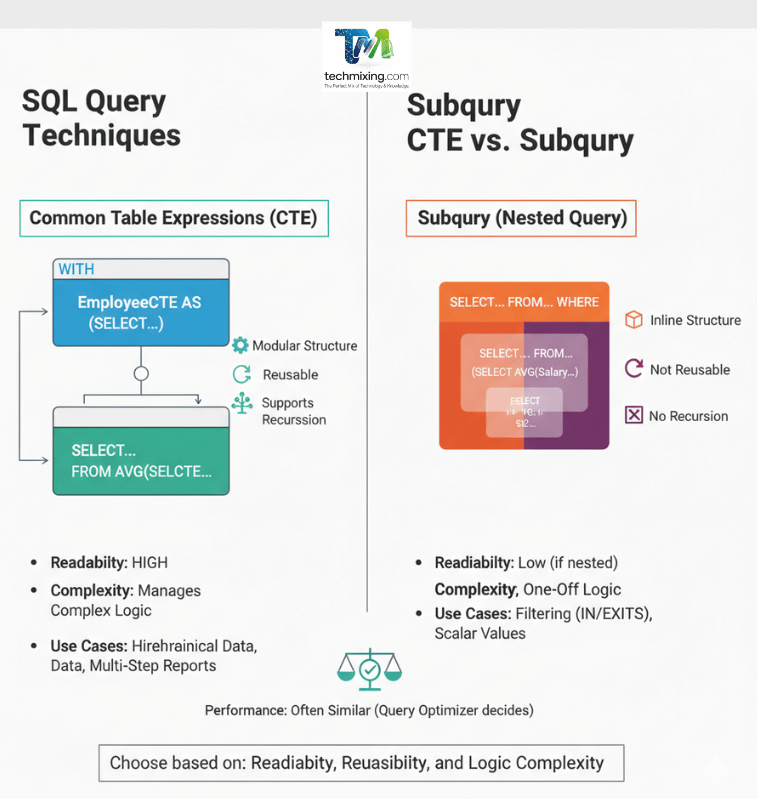
Key Differences Between CTE and Subqueries
| Feature | CTE | Subquery |
|---|---|---|
| Definition | Named temporary result set | Query nested within another query |
| Readability | Easier to read and maintain | Can become complex when nested |
| Performance | Can be optimized and reused | May execute multiple times |
| Recursion | Supports recursion | Does not support recursion |
| Scope | Exists only within a query | Exists inside its parent query |
| Reusability | Can be referenced multiple times | Must be rewritten if reused |
Structural Comparison: CTE vs Subquery
While both serve to simplify SQL logic, their structure defines their best use.
A CTE sits before your main query, creating a named “virtual view.”
A subquery sits inside your main query, often hidden within clauses like WHERE, FROM, or SELECT.
Readability and Maintainability Differences
CTEs shine when queries become complex or lengthy. They separate logic clearly and make debugging far easier. Subqueries, on the other hand, can quickly turn into “spaghetti SQL” if overused.
Performance and Optimization Aspects

A common misconception is that one is inherently faster than the other. In reality, for most non-recursive cases where a simple CTE can be written as an equivalent subquery, the modern database engine’s query optimizer often treats them similarly, generating the same execution plan. The performance impact often comes down to the database system and the specific query structure.
Readability First: A widely adopted best practice is to prioritize readability using CTEs for complex logic and only switch to an alternative (like a temporary table or a subquery) if performance profiling reveals a bottleneck directly attributable to the CTE structure.
No Absolute Rule: The performance difference is not predictable and is highly dependent on the database management system (DBMS), query complexity, and data size.
Recursive Queries: Why CTEs Win Here
When handling hierarchical data, such as organizational charts or folder structures, only CTEs can perform recursion efficiently.
Use Cases and Best Practices
Both CTEs and subqueries are vital SQL tools, but knowing when to use one over the other can drastically improve code readability and performance.
When to Prefer CTEs
- Complex Logic Splitting:
If your SQL query has multiple layers of logic—aggregations, joins, and conditions—use CTEs to break the problem into smaller, logical chunks. - Recursive Operations:
Tasks like generating organizational hierarchies, category trees, or computing transitive relationships are best handled by recursive CTEs. - Readability Priority:
When clarity matters more than execution speed (for example, in long reporting queries), CTEs make maintenance and understanding easier. - Reusable Logic:
When you need the same computed dataset in multiple parts of a query, define it once as a CTE and reuse it—avoiding duplication.
When Subqueries Make More Sense
- Simple Inline Computations:
For one-time checks (like filtering salaries above the average), subqueries are compact and elegant. - Data Filtering in WHERE Clauses:
When the result of a query depends on another small dataset, subqueries within WHERE or HAVING clauses are quick and efficient. - Single-Level Dependencies:
When a result doesn’t need to be referenced multiple times, a subquery often performs just as well.
Common Mistakes Developers Make with CTEs and Subqueries
Even seasoned SQL developers sometimes make errors when using these tools. Let’s review the most common pitfalls.
Performance Pitfalls
- Overusing CTEs:
Some developers assume CTEs always improve performance. However, in many SQL engines, CTEs are re-evaluated each time they’re referenced—causing slower execution. - Nested Subqueries:
Deeply nested subqueries can confuse the optimizer and lead to redundant data scans.
Tip: Always check the query execution plan to understand how your SQL engine processes the query.
Logical and Syntax Errors
- Forgetting to define column aliases properly in CTEs.
- Using aggregate functions without grouping in subqueries.
- Writing subqueries that return more than one row in contexts expecting a single scalar value.
Proper testing and incremental query writing can help avoid these issues.
Example: Comparing CTE and Subquery Solutions for the Same Problem
Let’s look at a real-world example to compare both techniques.
Problem Statement
Find all departments with an average employee salary greater than 70,000.
Subquery Approach
SELECT DepartmentID, DepartmentName
FROM Departments
WHERE DepartmentID IN (
    SELECT DepartmentID
    FROM Employees
    GROUP BY DepartmentID
    HAVING AVG(Salary) > 70000
);
This works well but can get messy if we need to reuse the aggregated data later in the same query.
CTE Approach
WITH SalaryCTE AS (
    SELECT DepartmentID, AVG(Salary) AS AvgSalary
    FROM Employees
    GROUP BY DepartmentID
)
SELECT d.DepartmentID, d.DepartmentName
FROM Departments d
JOIN SalaryCTE s ON d.DepartmentID = s.DepartmentID
WHERE s.AvgSalary > 70000;
Here, the logic is clear, readable, and reusable. You can easily extend this query to include more metrics, such as total employees or maximum salary, without adding complexity.
SQL Optimization Tips for Better Query Performance
- Use EXPLAIN or EXECUTION PLAN:
Always analyze your SQL engine’s query plan before finalizing complex queries. - Index Strategically:
Index columns used in joins or subqueries to improve performance. - Avoid Over-Nesting:
Too many nested subqueries can lead to redundant scans and poor performance. - Use CTEs Wisely:
If you need recursion or code readability, go for CTEs—but avoid using them excessively in performance-critical queries. - Materialize Reusable Data:
In data-intensive tasks, consider using temporary tables if CTEs are recalculated multiple times.
FAQs About CTEs and Subqueries
1. What is the main advantage of a CTE over a subquery?
A CTE improves readability and organization. It lets you separate complex logic into modular blocks and reference results multiple times within a single query.
2. Are CTEs faster than subqueries?
Not always. Performance depends on your SQL engine and indexing. Some databases re-evaluate CTEs each time they’re called, making them comparable in speed to subqueries.
3. Can you nest CTEs like subqueries?
Yes! You can define multiple CTEs in a single query and even have one CTE reference another. This technique is common in multi-layered reporting queries.
4. Do all SQL databases support CTEs?
Most modern relational databases (e.g., SQL Server, PostgreSQL, Oracle, and MySQL 8.0+) support CTEs. However, older versions may not.
5. When should I not use a CTE?
Avoid CTEs when performance is critical and the query needs to be executed repeatedly on large datasets. In those cases, temporary tables or materialized views may perform better.
6. Are subqueries outdated compared to CTEs?
Not at all! Subqueries remain a fundamental part of SQL. They’re perfect for simple inline operations and are easier to use for small, isolated queries.
Conclusion: Choosing the Right SQL Technique for Efficiency
Both CTEs and subqueries are essential SQL features designed to handle complexity elegantly.
- Use CTEs when you need recursion, reusability, or improved readability.
- Use subqueries for quick inline calculations and simple filters.
Ultimately, both CTEs and subqueries are essential tools in the SQL developer’s kit. The choice between them should be driven by a balance of query complexity, the need for logical structuring, and code maintainability. For large, multi-step queries, CTEs are the clear winner for superior organization.
Discover more from Technology with Vivek Johari
Subscribe to get the latest posts sent to your email.

