
Introduction to Intelligent Query Processing (IQP)
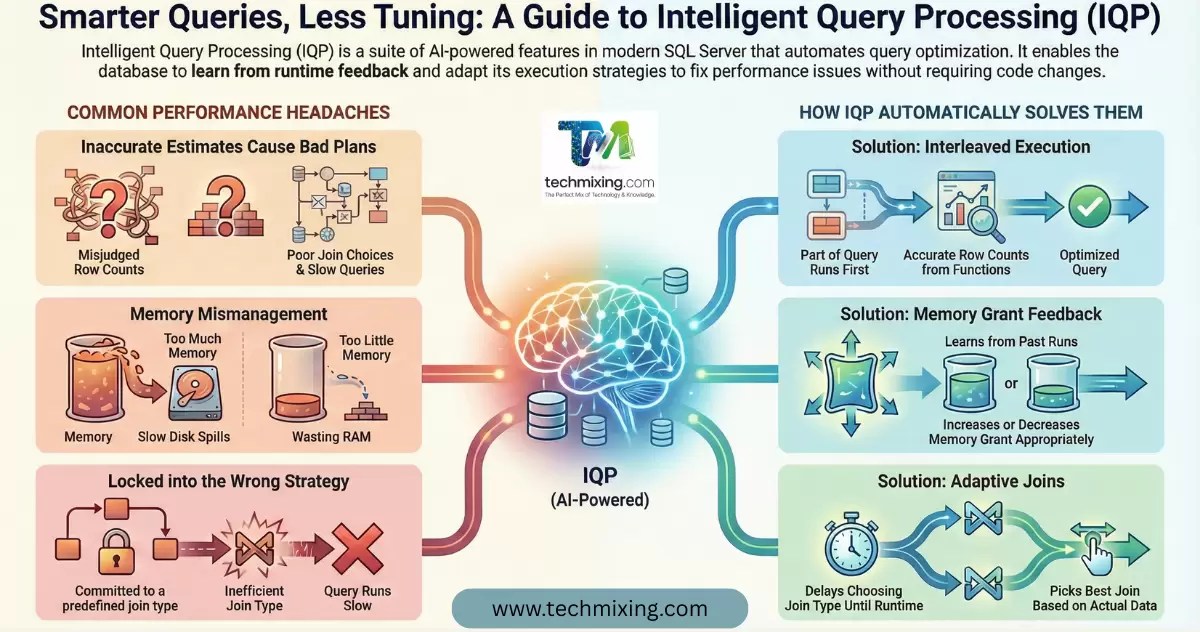
SQL Server has come a long way from the days when query tuning depended solely on indexes, heuristics, and DBA intervention. Today, SQL Server uses AI-powered Query Optimization to automatically improve performance, reduce spills, fix cardinality issues, and adapt to runtime conditions. Intelligent Query Processing (IQP) represents Microsoft’s major leap toward smarter, self-adjusting database systems.
IQP enables the engine to learn from runtime feedback, adjust execution strategies, and continuously refine decisions—without requiring major application changes. This shift mirrors AI principles seen across the industry: self-learning, automation, and adaptive decision-making.
SQL Server’s IQP framework helps solve real-world problems like unpredictable workloads, fluctuating row counts, parameter sniffing, and memory misallocation.
Why AI-Powered Optimization Matters Today
Modern applications generate highly dynamic traffic. A query that runs fast today may struggle tomorrow due to:
- Unexpected data growth
- Non-uniform distributions
- Parameter sensitivity
- Increased concurrency
- Changes in query plans due to statistics updates
AI-powered optimization reduces dependency on manual intervention by allowing SQL Server to self-adjust using runtime intelligence. Instead of DBAs constantly tuning indexes, rewriting SQL, or analyzing regressions, IQP helps maintain consistency automatically.
Manually tuning everything is simply impractical for today’s scale. That’s where IQP shines.
Core Concepts Behind AI-Powered Query Optimization
Learning from Runtime Feedback
SQL Server now observes repeat executions of a query and uses that data to improve future decisions. For example:
- If a query spills to disk, SQL Server learns and adjusts memory grants.
- If row counts differ significantly from estimates, SQL Server adjusts join strategies.
This introduces feedback loops, similar to AI model refinement.
Adaptive vs. Automatic Optimization
- Adaptive features adjust execution behavior during query processing.
- Automatic features adjust behavior between executions.
IQP includes both types.
Intelligent Query Processing Features in SQL Server
Major IQP components include:
- Adaptive Joins
- Memory Grant Feedback
- Interleaved Execution
- Table Variable Deferred Compilation
- Batch Mode on Rowstore
- Approximate Query Processing
- Intelligent Cardinality Estimation (CE)
Each addresses a common performance pain point.
Deep Dive: Adaptive Joins
Adaptive Joins allow the SQL Server optimizer to delay choosing a join type until runtime. Instead of committing to a Nested Loop or Hash Join, SQL Server builds a flexible plan that chooses dynamically based on actual row counts.
How Adaptive Joins Work
- SQL Server begins execution assuming a Nested Loop join may be ideal.
- As rows flow in, SQL Server evaluates whether a Hash Join would be more efficient.
- It switches automatically if estimates differ too much.
Benefits
- Handles parameter sniffing better
- Adapts to skewed data
- Eliminates poor join choices caused by inaccurate statistics
Adaptive joins significantly improve reliability in unpredictable workloads.
Deep Dive: Memory Grant Feedback
Memory Grant Feedback (MGF) is one of the smartest features added to SQL Server. It solves the problem of queries receiving too much or too little memory.
The Problem
- Too little memory = spills to tempdb, slow performance
- Too much memory = wasted RAM, concurrency bottlenecks
How MGF Works
After a query runs, SQL Server stores feedback about memory usage:
- If memory was insufficient → grant is increased next time
- If memory was excessive → grant is decreased
This creates a self-optimizing feedback loop.
Benefits
- Eliminates tempdb spills
- Improves concurrency
- Reduces unpredictable slowdowns
MGF is a prime example of AI-like behavior inside SQL Server.
Deep Dive: Interleaved Execution
Interleaved Execution helps solve long-standing issues with multi-statement table-valued functions (MSTVFs).
Before IQP, SQL Server assumed MSTVFs always returned one row, leading to terrible plans.
What Interleaved Execution Does
SQL Server now executes the first part of the plan, gets actual row counts, and then optimizes the rest of the query.
Why It Matters
- Far more accurate cardinality
- Better join choices
- Faster execution times
As workloads grow more complex, Interleaved Execution becomes indispensable.
Deep Dive: Approximate Query Processing
Approximate Query Processing uses probabilistic algorithms like HyperLogLog to speed up aggregates on large datasets.
Common function:
SELECT APPROX_COUNT_DISTINCT(CustomerID) FROM Orders;
This sacrifices minimal accuracy in exchange for massive performance improvements—especially useful in analytics, dashboards, and telemetry workloads.
Intelligent Cardinality Estimation
Cardinality Estimation (CE) predicts how many rows a query will return. AI-inspired CE in SQL Server now:
- Uses multiple models
- Tracks runtime deviations
- Adjusts estimates over time
This is critical for eliminating misestimates that cause:
- Bad join choices
- Incorrect memory grants
- Slow query performance
IQP in Azure SQL Database: Always-On AI Engine
Azure SQL adds even deeper AI and automation:
Automatic Tuning
Azure can detect query regressions and automatically force a better plan.
Auto-Indexing
Azure can identify missing indexes and create them automatically.
Performance Insights
Azure uses telemetry to identify recurring bottlenecks, parameter sniffing, and misconfigurations.
This makes Azure SQL a fully intelligent, self-healing database platform.
Real-World Benefits of AI-Powered Query Optimization
- Dramatically faster query performance
- More consistent execution times
- Less reliance on manual tuning
- Automatic adaptation to workload changes
- Reduced tempdb usage
- Built-in protection against regressions
IQP doesn’t replace DBAs—it frees them from constant firefighting so they can focus on architecture and optimization.
Limitations and Considerations
- Requires modern database compatibility levels
- Not all workloads benefit equally
- Some features may require regression testing
- Rarely, adaptive behavior may cause performance variance
- Understanding execution plans remains essential
Best Practices for Maximizing IQP
- Use the latest compatibility level (140+ recommended)
- Enable Query Store to monitor plan behavior
- Keep statistics updated
- Combine IQP with good indexing practices
- Test memory-intensive queries under load
Practical Examples (T-SQL)
Detect if Adaptive Joins are used
SELECT *
FROM sys.dm_exec_query_stats AS qs
CROSS APPLY sys.dm_exec_query_plan(qs.plan_handle) AS qp
WHERE qp.query_plan.value('(/ShowPlanXML/BatchSequence/Batch/Statements/StmtSimple/QueryPlan/RelOp/@Adaptive)', 'varchar(5)') = 'true';
Check Memory Grant Feedback usage
SELECT *
FROM sys.dm_exec_query_stats
WHERE last_rows > 0
AND (min_memory_grant_kb <> max_memory_grant_kb);
These examples help DBAs validate whether IQP features are actively improving the workload.
Five Common Mistakes to Avoid
- Assuming AI replaces monitoring
- Leaving compatibility levels outdated
- Ignoring Query Store insights
- Misinterpreting adaptive plans as “unstable”
- Forgetting that IQP features still require good indexing
Mostly Asked Interview Questions
1. Is Intelligent Query Processing the same as AI?
Not exactly. IQP uses AI-inspired techniques like feedback loops and adaptive behavior but not full machine learning models.
2. Do I need to change my SQL code to use IQP?
No. Most features work automatically when compatibility levels are updated.
3. Does IQP fix parameter sniffing?
It reduces many sniffing-related issues using adaptive joins and memory grant feedback.
4. Is IQP available on older SQL Server versions?
Only SQL Server 2017+ includes core IQP features. SQL Server 2019 and Azure SQL offer the full suite.
5. Does IQP increase resource usage?
Generally no. Most features reduce resource consumption by improving plan accuracy.
6. Can I turn off Intelligent Query Processing?
You can disable individual features, but it’s recommended to keep them enabled unless troubleshooting a regression.
Conclusion: The Future of AI in SQL Server Query Optimization
AI-Powered Query Optimization in SQL Server is transforming how performance tuning works. Intelligent Query Processing provides self-adjusting plans, smarter memory usage, adaptive decisions, and more accurate row estimates. As Microsoft continues adding AI capabilities – especially in Azure – the future of SQL Server performance will rely less on manual intervention and more on automation, learning, and intelligent feedback.
These advancements empower DBAs, developers, and businesses to achieve high performance with less tuning effort and more predictable outcomes.
Discover more from Technology with Vivek Johari
Subscribe to get the latest posts sent to your email.

