
“I knew the answer… but I still didn’t get selected.”
A candidate once told me this after an interview.
He had prepared for days.
He watched interview videos. He memorized answers. He practiced “Tell me about yourself.” He even prepared responses for questions about his strengths, weaknesses and salary expectations.
But during the interview, something unexpected happened.
The interviewer asked:
“Tell me about a difficult situation you handled at work.”
He paused.
Then he gave what sounded like a perfect answer.
But there was one problem.
It did not sound like his answer.
It sounded memorized.
When the interviewer asked a follow-up question, he struggled to explain what he had personally done, why he made certain decisions and what he learned from the experience.
And that is when the real problem became clear.
Interviews are not about memorizing perfect answers
They are about helping the interviewer understand:
- How you think
- How you communicate
- How you solve problems
- How you handle challenges
- How you work with others
- How you take ownership
- How you learn from mistakes
- How you can create value in the role
As an HR Head and Career Coach, I have seen this happen with:
Freshers attending their first interview
Professionals with 5 to 10 years of experience
Senior professionals with 20+ years of experience
Experience may change.
But one thing remains the same: the interviewer wants evidence, not just impressive words.
So, whether you are preparing for your first job interview or your next leadership role, here are 15 practical interview tips to help you perform with greater confidence.
1. Prepare Stories, Not Just Answers
One of the biggest interview mistakes is trying to memorize answers to 50 or 100 questions.
That approach rarely works.
Interview questions can be asked in many different ways. If you memorize one exact answer, you may struggle when the interviewer changes the wording or asks a follow-up question.
Instead, prepare 8 to 10 strong stories from your professional, academic or internship experience.
Your stories can include:
- A difficult challenge you solved
- An achievement you are proud of
- A mistake you learned from
- A failure that helped you grow
- A conflict you resolved
- A time you took initiative
- A difficult deadline you managed
- A process you improved
- A situation where you worked as part of a team
- A problem you solved independently
Pro Tip: Use the STAR Method

A simple structure for behavioral interview questions is:
Situation: What was happening?
Task: What was your responsibility?
Action: What did you personally do?
Result: What happened because of your actions?
Example
Instead of saying:
“I am good at solving problems.”
Say:
“In my previous role, our team was facing delays because of a manual process. I reviewed the workflow, identified the main bottleneck and suggested a more structured process. After implementation, we reduced the turnaround time and improved overall efficiency.”
One strong story can help you answer multiple interview questions.
2. Keep “Tell Me About Yourself” Focused
This is one of the most common interview questions and also one of the most frequently answered poorly.
Many candidates start from childhood.
They explain where they were born, where they studied, every job they have ever held and details that have no connection with the position.
The interviewer is asking about you as a professional.
A simple structure is:
Present → Past → Future

Present
What do you currently do?
Past
What relevant experience, education or skills helped you get here?
Future
Why are you interested in this opportunity?
Pro Tip
Keep your answer relevant and ideally within 60 to 90 seconds.
Your introduction should help the interviewer quickly understand your background and why you may be a good fit for the role.
3. Don’t Just Say You Are Hardworking. Prove It.
Almost every interviewer hears statements such as:
“I am hardworking.”
“I am a quick learner.”
“I am a team player.”
“I am very passionate.”
The problem is not that these qualities are unimportant.
The problem is that everyone says them.
So how do you stand out?
Use evidence.
Instead of saying:
“I am a quick learner.”
Try:
“When my team introduced a new tool, I took the initiative to learn it quickly and used it to improve my reporting process.”
Pro Tip
Replace claims with proof.
A real example is usually more powerful than a list of positive adjectives.
4. Be Honest About Your Weaknesses
The question:
“What is your biggest weakness?”
makes many candidates nervous.
That is why they often give answers such as:
❌ “My weakness is that I work too hard.”
❌ “I am a perfectionist.”
❌ “I don’t really have any weaknesses.”
These answers often sound rehearsed.
Instead, choose a genuine development area and show how you are improving it.
Use this structure:
Weakness → Awareness → Action → Improvement

Example
“Earlier in my career, I sometimes spent too much time trying to perfect a task before sharing it for feedback. I realized that getting early feedback could improve the final result and save time. I now share initial versions earlier and incorporate feedback throughout the process.”
Pro Tip
The interviewer is not looking for perfection.
They are evaluating self-awareness, honesty and willingness to improve.
Avoid choosing a weakness that is a critical requirement of the job.
5. Turn Failures Into Growth Stories
A candidate once told me:
“I have never failed.”
Honestly, that answer is rarely convincing.
Everyone makes mistakes.
Everyone faces setbacks.
What matters is not whether you have ever failed.
The interviewer wants to understand:
- Did you take responsibility?
- Did you learn from the experience?
- Did you change your approach?
- Did you improve afterward?
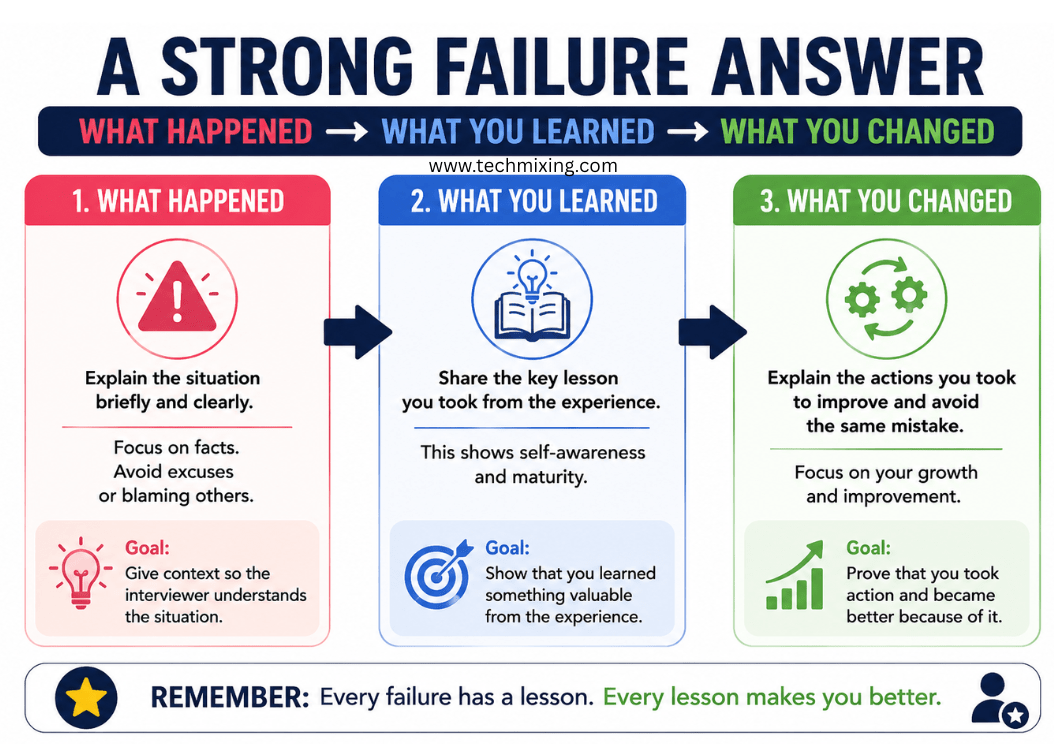
A Strong Failure Answer
What happened → What you learned → What you changed
Pro Tip
Always end your answer by explaining how the experience made you better.
A failure story without learning may sound like a risk.
A failure story with accountability and growth can demonstrate maturity.
6. Never Turn the Interview Into a Complaint Session
You may have had:
- A difficult manager
- A toxic work environment
- Poor leadership
- Unrealistic expectations
- A challenging company culture
Your experience may have been genuinely difficult.
But an interview is not the place to complain.
Avoid statements like:
❌ “My manager was terrible.”
❌ “The company was toxic.”
❌ “Nobody appreciated my work.”
Instead, stay factual and professional.
You can say:
“I learned a lot from the experience, but at this stage I am looking for an opportunity with broader responsibilities and stronger alignment with my long-term career goals.”
Pro Tip
Focus on what you are moving toward, not what you are running away from.
How you speak about your previous employer can influence how the interviewer sees your professionalism.
7. Numbers Make Your Story Stronger
Compare these two answers:
❌ “I improved the process.”
✅ “I improved the process and reduced turnaround time by approximately 30%.”
Which answer is more memorable?
The second one.
Numbers provide context and make your contribution easier to understand.
Whenever possible, quantify your achievements through:
- Revenue increased
- Time saved
- Costs reduced
- Productivity improved
- Targets achieved
- Errors reduced
- Customer satisfaction improved
- Projects delivered
- Team size managed
Pro Tip
You do not always need an exact number.
If appropriate, you can use reasonable descriptions such as:
- Approximately
- Around
- More than
- Nearly
- Improved significantly
The goal is to make your impact specific.
8. Don’t Panic When You Don’t Know an Answer
No candidate knows everything.
And most experienced interviewers understand that.
The bigger problem is pretending to know something when you do not.
Instead, say something like:
“I haven’t handled this directly yet, but based on my understanding, I would approach the situation by…”
Then explain your thought process.
Pro Tip
Sometimes the interviewer is evaluating how you think, not simply what you already know.
Show that you can:
- Understand the problem
- Gather information
- Explore possible solutions
- Ask for guidance when needed
- Learn from the experience
Learning agility is a valuable professional skill.
9. Focus on Your ACTION in Every Story
This is one of the most important behavioral interview tips.
Many candidates spend several minutes explaining the problem.
Then they spend only a few seconds explaining what they actually did.
That is backwards.
The interviewer wants to know:
What did YOU do?
When using the STAR method, keep the situation brief and focus on:
Action + Result
Pro Tip
Use action-oriented language such as:
- I analyzed
- I identified
- I proposed
- I coordinated
- I implemented
- I resolved
- I improved
- I communicated
- I led
If the achievement was a team effort, give credit to the team while clearly explaining your individual contribution.
10. Never Walk Into a Salary Discussion Unprepared
Salary questions can become difficult when candidates have not prepared.

Before the interview, understand your three numbers:
1. Ideal Salary
The compensation you would be happy to receive.
2. Target Salary
The realistic range you are aiming for.
3. Minimum Acceptable Salary
The minimum compensation you would realistically accept.
Consider:
- Your skills and experience
- The responsibilities of the role
- Current market conditions
- Location
- Industry
- Benefits
- Bonuses and incentives
- Career growth opportunities
Pro Tip
Research your market value before the salary discussion.
Never say:
❌ “Anything is fine.”
❌ “You decide.”
❌ “I haven’t thought about it.”
A professional approach could be:
“Based on my experience, the responsibilities of this role and my understanding of the market, I am targeting a range of ₹X to ₹Y. However, I am open to discussing the overall opportunity and compensation package.”
11. Research the Company Properly
Many candidates answer:
“Your company is very reputed.”
That tells the interviewer very little.
Before the interview, research:
- What the company does
- Its products or services
- The industry
- The job description
- The team’s responsibilities
- Recent developments or achievements
- Why the opportunity genuinely interests you
Pro Tip
Connect these three things:
Company + Role + Your Career Direction

For example:
“I am particularly interested in this role because my experience in [area] aligns with the responsibilities, and I am also interested in the company’s work in [specific area].”
Specific answers demonstrate preparation.
Generic answers are easily forgotten.
12. Ask Thoughtful Questions
When the interviewer asks:
“Do you have any questions for us?”
Do not automatically say:
“No, I don’t have any questions.”
This is still part of the interview.
Your questions can demonstrate curiosity, preparation and genuine interest.
Consider asking:
“What would success look like in the first six months?”
“What is the biggest challenge the person in this role will need to solve?”
“How is performance measured in this position?”
“What does the team structure look like?”
“What are the next steps in the hiring process?”
Pro Tip
Prepare at least three thoughtful questions before every interview.
Remember, you are also evaluating whether the role is the right fit for you.
13. Practice Your Answers Out Loud
Thinking about an answer and speaking it confidently are two completely different skills.
Under pressure, even a well-prepared candidate may start saying:
“Umm…”
“Actually…”
“Basically…”
“You know…”
Pro Tip
Record yourself answering common interview questions.
Then review:
- Are your answers too long?
- Are you using too many filler words?
- Are you speaking clearly?
- Do you sound confident?
- Are you answering the actual question?
- Are you providing examples?
You do not need to memorize every sentence.
Practice until your stories and key points feel natural.
14. Prepare Properly for Virtual Interviews
A virtual interview is still a professional interview.
Technical problems can create unnecessary stress and affect your confidence.
Before the interview, check:
💻 Internet connection
🎧 Audio quality
📷 Camera position
💡 Lighting
🏠 Background
🔋 Device battery
🔕 Phone notifications
Pro Tip
Join the meeting 5 to 10 minutes early.
Keep these nearby:
- Your resume
- The job description
- Your key achievements
- Notes about the company
- Questions for the interviewer
But do not read your answers from the screen.
Use your notes only as a quick reference.
15. Create Confidence, Not Perfect Answers
This is the most important interview lesson.
Before answering any question, pause and ask yourself:
“What is the interviewer actually trying to understand about me?”
Then answer that.
An interview is not a school examination.
You do not need to give a textbook answer.
It is a professional conversation where you need to demonstrate:
✔ I understand the role.
✔ I have relevant skills.
✔ I can solve problems.
✔ I can communicate clearly.
✔ I can learn and adapt.
✔ I can take responsibility.
✔ I can work with others.
✔ I can create value.
Final Interview Advice for Freshers and Experienced Professionals
Whether you have 0 years or 20+ years of experience, remember:
You do not need to be the most perfect candidate in the room.
You need to help the interviewer feel confident about choosing you.
Your experience may be different.
Your career journey may be different.
Your answers may not sound exactly like anyone else’s.
And that is perfectly fine.
In fact, authenticity is often your advantage.
Remember:
📄 Your resume gets you noticed.
🤝 Your interview builds trust.
🗣️ Your communication makes your value visible.
Before your next interview:
- Prepare your stories
- Know your achievements
- Understand your strengths
- Learn from your failures
- Practice your answers aloud
- Research the company
- Prepare questions
- Understand your market value
And most importantly:
Stop trying to sound perfect. Start showing your real value.
The best interview answers are not necessarily the most polished or complicated.
They are:
Relevant. Specific. Honest. Structured. And supported by real examples.
FAQ About Interview Preparation
How many interview questions should I prepare?
Instead of memorizing dozens of answers, prepare 8 to 10 strong stories from your career, internship, projects or academic experience. These stories can be adapted to answer many behavioral interview questions.
What is the best method for answering behavioral interview questions?
The STAR method is one of the most effective approaches:
Situation → Task → Action → Result
Keep the situation brief and focus on what you personally did and the result you achieved.
How long should my “Tell Me About Yourself” answer be?
Ideally, keep it between 60 and 90 seconds. Focus on your present role or background, relevant experience and what you are looking for next.
What should I do if I don’t know the answer in an interview?
Do not panic or pretend. Be honest, explain how you would approach the problem and demonstrate your willingness to learn.
Should I memorize interview answers?
No. Memorizing every answer can make you sound rehearsed and can make follow-up questions difficult. Prepare key points and real stories instead.
How should I answer questions about salary expectations?
Research the market beforehand and know your ideal salary, target range and minimum acceptable compensation. Consider the complete compensation package, not just the fixed salary.
Final Thoughts
Every interview is an opportunity to tell your professional story.
You are not there simply to answer questions.
You are there to demonstrate the value you can bring.
Prepare well.
Stay authentic.
Use real examples.
Communicate clearly.
And walk into the interview knowing:
“I am not here to prove that I am perfect. I am here to show why I can create value.”
Did this guide help you?
🔖 Save it before your next interview.
🔁 Share it with someone preparing for an interview.
💬 Which interview question do you find the most difficult to answer?
Follow Megha Johari for practical career, resume, LinkedIn, interview and professional growth tips.
Discover more from Technology with Vivek Johari
Subscribe to get the latest posts sent to your email.


